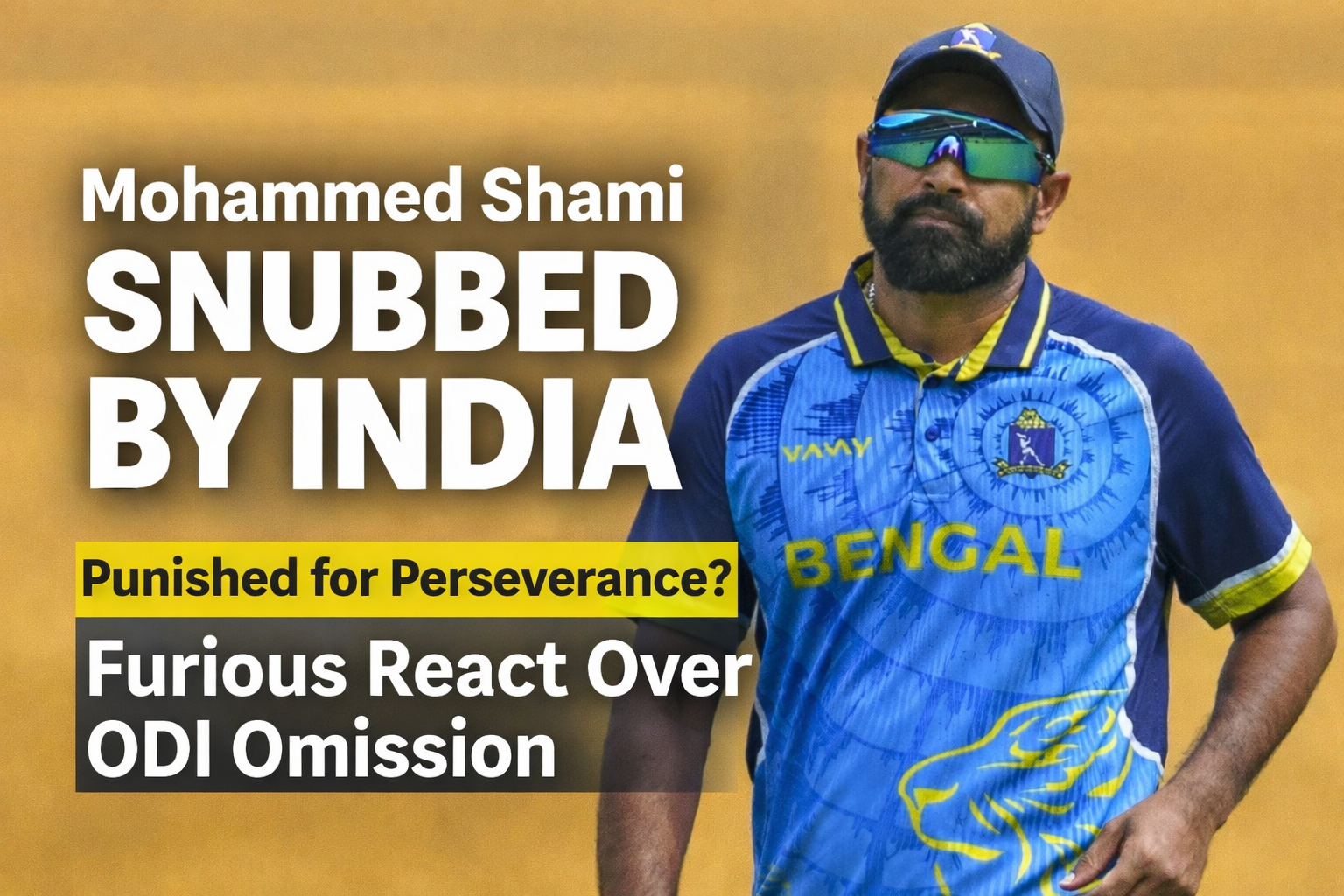
Mumbai: Mohammed Shami’s exclusion from India’s ODI squad for the New Zealand series beginning January 11, 2026, has triggered widespread disbelief and anger—not without reason. Announced on January 3 by the Ajit Agarkar–led selection committee, the decision goes far beyond routine selection debate. It raises uncomfortable questions about fairness, vision and whether Indian cricket still truly rewards performance and perseverance.
A Career Defined by Impact, Not Longevity
Shami is not a peripheral figure in Indian cricket; he is one of its most decisive fast bowlers of the modern era. Since his international debut in 2013, the seamer from Uttar Pradesh has built a reputation for late swing, relentless accuracy and an uncanny ability to rise in high-pressure matches. His numbers are elite by any standard—over 200 Test wickets and 195 ODI wickets—and his influence in ICC tournaments is undeniable.
His 7/57 against New Zealand in the 2023 ODI World Cup semi-final remains etched in memory as one of the greatest spells in World Cup history. Two years later, in the 2025 Champions Trophy, Shami once again proved his big-match temperament, taking nine wickets including a five-wicket haul in the final to help India lift the trophy. That Champions Trophy, in March 2025, was his last international appearance—and it ended with authority, not decline.
Injuries, Then Accountability
Following the Champions Trophy, Shami’s journey took a familiar turn. A recurring knee issue forced him out of international cricket, ruling him out of the Australia tour and later the Test series against England. The message from the selectors was clear: prove fitness through domestic cricket.
Shami responded in the only way he knows—through hard work. In an era where senior international players rarely play sustained domestic cricket, he embraced the grind across formats for Bengal during the 2025–26 season. He bowled more than 300 overs, across red-ball, List A and T20 competitions, collecting over 40 wickets and showing no signs of physical fragility.
Numbers That Silence Doubt
In the Ranji Trophy, Shami picked up 20 wickets in just four matches at an average of 18.60, regularly bowling long spells of around 20 overs per innings. In the Syed Mushtaq Ali Trophy, he claimed 16 wickets in seven games, while in the Vijay Hazare Trophy he took 11 wickets in five matches at an average of 22.27, with an economy rate of 5.65. On the very day the ODI squad was announced, he delivered figures of 3/55 and remained unbeaten on 25, underlining his match readiness.
Few international cricketers have shown such commitment to domestic cricket in recent years. Fewer still have backed it up with consistent performance across all formats.
Youth Over Experience—At What Cost?
Despite this, the selectors opted for a pace attack featuring Mohammed Siraj, Harshit Rana, Prasidh Krishna and Arshdeep Singh. All are talented bowlers, but none carry Shami’s experience in high-pressure international cricket. The justification, as explained by R Ashwin, revolves around “optics” and planning for the 2027 ODI World Cup. At 35, doubts persist about whether Shami can maintain rhythm, speed and fitness over another global cycle.

But this logic appears deeply flawed. Fast bowlers do not suddenly lose effectiveness at 35, especially those who rely on skill and control rather than raw pace. Shami’s recent domestic workload directly contradicts claims about diminished stamina or rhythm. More importantly, bilateral series—particularly against familiar opponents like New Zealand—are meant to test combinations and provide balance, not to prematurely close doors on proven match-winners.
Voices from the Ground
The backlash has been sharp and telling. Bengal coach Laxmi Ratan Shukla described the omission as “shameful” and an “injustice,” highlighting that no international player has put in as much domestic effort as Shami in recent times. His childhood coach, Badruddin Siddiqui, questioned what more the bowler could possibly prove, pointing to his fitness, form and skill. Former cricketers and fans have echoed similar sentiments, urging Shami to continue performing until he becomes impossible to ignore.
A Dangerous Precedent
This decision goes beyond one player. It sends a worrying message that even after fulfilling every condition set by selectors—fitness, form and domestic performance—selection is not guaranteed. Such an approach risks discouraging players from investing in domestic cricket and undermines the culture of merit-based progression that Indian cricket has long championed.
For Shami, the omission could mark the beginning of an unceremonious fade from international cricket, pushing him toward an IPL-only future. For the team, it risks losing a bowler who thrives under pressure and mentors younger pacers through example rather than words.
Why This Needs Rethinking
The 2027 World Cup is still over a year away. There is ample time to groom younger fast bowlers without discarding a proven performer who continues to deliver. Indian cricket has historically flourished when experience and youth coexist—2011 being the most obvious example.
Mohammed Shami’s exclusion is not a bold vision-driven move; it is a cautious, short-sighted decision that prioritises hypotheticals over hard evidence. Indian cricket does not need to choose between the future and the present. It needs both—and right now, leaving out Shami weakens the team.
If merit still matters, the door for Mohammed Shami should not just remain open—it should never have been closed in the first place.